
Production of Maggots using Different Manure Substrates for Fish Feed Supplements
1Department of Fisheries and Aquaculture, Joseph Sarwuan Tarka University, P.M.B. 2373, Makurdi, Nigeria.
2Livestock Department, Agricultural research council of Nigeria, Mabushi, Abuja, Nigeria.
3Department of Biological Sciences, Benue State University, Makurdi, Nigeria.
*Correspondence
Simi Rose AlambaEmail:
rosesimialamba@gmail.comAbstract
The increasing demand for sustainable protein sources and effective waste management solutions has led to the exploration of insect larvae, particularly maggots, as a valuable resource. This study evaluates the impact of different manure substrates and manure weight on maggot production. Three manure types; Cow Manure (CM), Poultry Manure (PM), and Swine Manure (SM) were tested at three weight levels (5kg, 10kg, and 20kg) to determine their effectiveness in maggot yield. The experiment followed a Randomized Complete Block Design (RCBD), and maggot production was carried out using the wetting method with blood as an attractant. Results demonstrated a significant effect (p<0.05) of manure type and weight on maggot yield. Poultry Manure consistently yielded the highest maggot biomass across all weight levels, followed by Swine Manure, while Cow Manure produced the lowest yields. A positive correlation was observed between manure weight and maggot production, with higher manure quantities supporting greater yields. This suggests that nutrient availability and microbial activity play a role in optimizing larval growth. The findings show the potential of Poultry Manure as the most effective substrate for large-scale maggot production, offering an eco-friendly alternative protein source for livestock and fish feed and contributing to organic waste recycling.
Keywords
Maggot production, Cow Manure, Poultry Manure, Swine Manure, Organic waste recycling, Substrates, Fish feed.
Citation
Alamba, S.R., Malomo, G.A., Shima, J.N., 2025. Production of Maggots using Different Manure Substrates for Fish Feed Supplements. Adv. Fish. Vet. Sci., 1(1): 7-15.
Introduction
The increasing demand for sustainable food sources, coupled with the growing concern over waste management (Iqbal, 2023a), has fostered interest in the production of insects, particularly maggots, as a viable solution to both challenges. Insects, specifically larvae of black soldier flies (Hermetia illucens), have been identified as a promising alternative protein source for animal feed, contributing to the circular economy by recycling organic waste into valuable biomass (Adebayo et al., 2021). The rearing of maggots (or larvae) on various organic substrates has been widely explored to optimize production efficiency and sustainability, with manure being one of the most abundant and nutrient-rich substrates for maggot cultivation (Jucker et al., 2020).
Manure, a by-product of livestock farming, is often considered a waste material, yet it is rich in nutrients like nitrogen, phosphorus, and potassium, making it an ideal substrate for the growth and development of insect larvae (Shumo et al., 2019). The utilization of manure as a substrate in maggot production can serve multiple purposes; it reduces the environmental burden of waste disposal, decreases the need for synthetic fertilizers, and provides a sustainable protein source for various industries, including animal feed, aquaculture, and even human consumption (Pastor et al., 2015: Sanchez Matos et al., 2020).
Each type of manure has distinct characteristics in terms of nutrient composition, moisture retention capacity, and microbial content, which may significantly impact maggot production (Kim et al., 2015). Furthermore, the weight or amount of manure provided to larvae during rearing is another factor that could influence maggot yield. The optimal manure weight or mass has yet to be systematically studied, with existing research often focusing on substrate type or environmental conditions (Koné et al., 2017). While several studies have evaluated the use of different organic substrates in maggot production (Bruno etal., 2024: Shumo et al., 2019: Albalawneh et al., 2024), research specifically focusing on the comparative efficacy of Cow Manure (CM), Poultry Manure (PM), and Swine Manure (SM) remains limited. Understanding the impact of manure weight on maggot yield is important for the production process in a controlled and efficient manner. This study evaluates the impact of different manure substrates and manure weight on maggot production.
Materials and Methods
Production and harvesting of maggot
The maggot production was carried out using the wetting method as described previously (Ezewudo et al, 2014). There were three different treatments each triplicated in three units using Randomized Complete Block Design (RCBD). Five (5kg), 10kg and 15kg of each manure type was collected from Tripple Z Farm Karshi, Rugan Madaki, Abacha Road and Ado piggery farms, Nasarawa State. Each of the substrate was mixed with blood (attractant) and were placed in sacks (replicated= 27bags). The three different organic substrates mixed with blood viz: Cow manure + blood, Pig manure + blood and poultry manure + blood were sprinkled with water twice daily, although the quantity of water added was adapted according to the climate and exposed for the odour to attract the house flies (Musca domestica) to perch and the females lay eggs on the manures. After which the mouth of the sacks were tied and kept under shade (to avoid direct effect of rainfall and sunlight) to allow for the development of maggot. After 2 days maggots were observed to have started emerging (hatched). Larvae development continued and matured maggots were harvested on day 4. Matured maggots were harvested using floatation method; the manure with maggots was first soaked in a basin filled with water, where in the maggots float on the water. They were therefore sieved with 3mm-mesh size net (Sogbesan et al., 2005). Using a weighing scale the harvested maggots from poultry manure, swine and cow manure were weighed and recorded, respectively. Maggot yield, measured in grams (g), was evaluated across three types of manure and the manure with the highest or best yield of maggots was determined.
Statistical analysis
The data obtained was organized and statistical significance was assessed using a two-way ANOVA followed by the Tukey test, where differences with a p-value less than 0.05 were considered significant (Ado et al., 2024).
Results
Table (1) shows the Interaction effect of manure weight and manure type on maggot yield. The impact of manure weight on maggot yield was evident across all types tested. Increasing the weight of manure generally resulted in higher maggot yields for each manure type. Cow Manure (CM), maggot yields increased significantly from 459 ± 60.2g (5kg) to 980 ± 8.17g (10kg) and further to 2490 ± 256g (20kg) (P < 0.05). Similarly, Poultry Manure (PM), maggot yields increased significantly from 1030 ± 101g (5kg) to 2040 ± 108g (10kg) and then to 4400 ± 248g (20kg) (P < 0.05). Swine Manure (SM) also showed significant increases in maggot yield as the weight of manure increased: from 670 ± 64.6g (5kg) to 1420 ± 112g (10kg) and to 3430 ± 258g (20kg) (P < 0.05). Significant differences in maggot yield were observed among different types of manure at each weight category (P < 0.05). For example, at 5kg of manure, Cow Manure (459 ± 60.2g) yielded significantly fewer maggots compared to Poultry Manure (1030 ± 101g) and Swine Manure (670 ± 64.6g). At 10kg and 20kg weights, Poultry Manure consistently yielded the highest maggot yields compared to Cow and Swine Manure. Specifically, at 10kg, Poultry Manure (2040 ± 108g) yielded significantly more maggots than Cow Manure (980 ± 8.17g) and Swine Manure (1420 ± 112g). Similarly, at 20kg, Poultry Manure (4400 ± 248g) outperformed both Cow Manure (2490 ± 256g) and Swine Manure (3430 ± 258g) in terms of maggot yield.
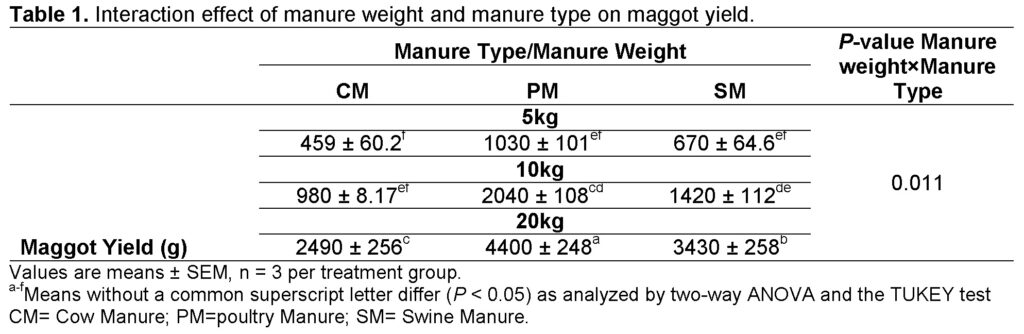
Figure (1) shows the effect of manure weight on maggot yield (Main effects from 2-way ANOVA). The figure shows maggot yield (measured in grams) plotted against three levels of manure weight: 5kg, 10kg, and 20kg. The analysis revealed a significant effect of manure weight on maggot yield (p < 0.05). As shown in figure (1), increasing the weight of manure generally resulted in higher maggot yields across all tested levels. At 5kg of manure, the mean maggot yield was 720.60g, which increased to 1479.20g and 3440.73g at 10kg and 20kg, respectively (p < 0.05).
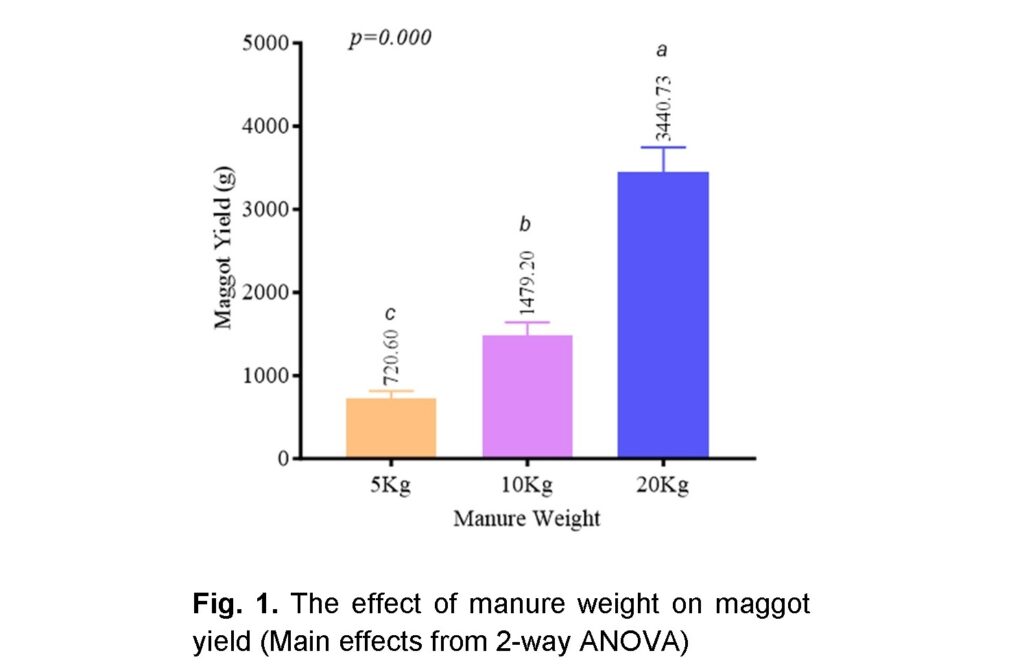
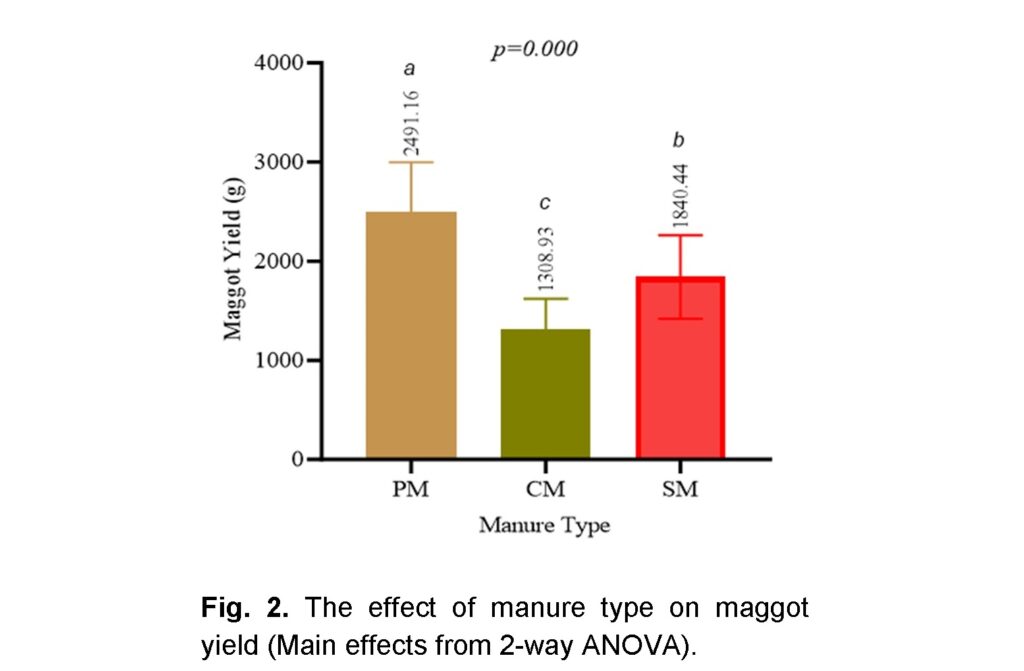
Figure (2) shows the effects of manure type on maggot yield based on the results from a two-way ANOVA analysis. The figure displays maggot yield (measured in grams) plotted for three types of manure: Cow Manure (CM), Poultry Manure (PM), and Swine Manure (SM). The analysis revealed a significant effect of manure type on maggot yield ( p < 0.05). As seen in the figure, Poultry Manure consistently resulted in the highest mean maggot yield across all tested manure types. Specifically, for Poultry Manure, the mean maggot yield was 2491.16g, followed by 1840.44g for Swine Manure while Cow Manure had the least yield of 1308.93g respectively (p < 0.05). This trend indicates that Poultry Manure was the most effective substrate for maggot production among the tested types.
Statistical analysis further confirmed significant differences in maggot yield between the different manure types (p < 0.05). At each manure type, significant differences in yield were observed.
Discussion
This study provides significant insights into the influence of manure type and weight on maggot yield, demonstrating substantial differences among Cow Manure (CM), Poultry Manure (PM), and Swine Manure (SM). The statistical analysis confirms that these factors are crucial in optimizing maggot production (P < 0.05). This section offers a comprehensive interpretation of the results, emphasizing the reasons behind the observed differences, with a specific focus on Swine Manure.
Poultry Manure consistently yielded the highest maggot biomass 1030 ± 101g (5kg), 2040 ± 108g (10kg), and 4400 ± 248g (20kg) as compared to swine and cow manures which is in agreement with the study of Anene et al. (2013) who reported similar results when carrying out aPreliminary investigations on quantity and proximate quality of maggots produced from four different sources of livestock. Our findings differ from reports by Hezron et al. (2019) who worked on Mass production of maggots for fish feed using naturally occurring adult houseflies (Musca domestica). The superior performance of PM may be primarily due to its high nutrient density, particularly in nitrogen, phosphorus, and potassium, which provide essential nutrients crucial for larval growth (Ofor and Alozie, 2011).
Cow Manure exhibited lower maggot yields than PM, with results of 459 ± 60.2g (5kg), 980 ± 8.17g (10kg), and 2490 ± 256g (20kg) which is in agreement with Anene et al. (2013). The restricted efficacy of CM can be attributed to its generally higher C:N ratio compared to PM, which can result in slower decomposition and less nutrient availability for larval consumption (Cavalli et al., 2017). The structural composition of CM, which often contains more fibrous material, may also inhibit larvae’s ability to efficiently extract and utilize the provided nutrients (Peguero et al., 2023).
Swine Manure showed intermediate values of maggot biomass: 670 ± 64.6g (5kg), 1420 ± 112g (10kg), and 3430 ± 258g (20kg). The findings indicate that while SM supports maggot growth, it does not match the levels achieved with PM. The reasons for Swine Manure low performance can be correlated to its inconsistent nutrient profile, largely from variations in pig diets (Huntington et al., 2007). This variability affects the nutrient content of the manure, which can include lower levels of essential vitamins and minerals necessary for effective larval growth (Sajeev et al., 2017).
Furthermore, high moisture content is a characteristic of Swine Manure that can benefit microbial activity but may also lead to anaerobic conditions if not managed appropriately, potentially resulting in odor issues and pathogen growth (Kim et al., 2015). The presence of antimicrobials and other additives in swine feed has been shown to influence the nutrient profiles of its manure, which can subsequently affect the performance of larvae that utilize this manure as a substrate. The use of antibiotics and metals as feed additives in swine can lead to an increase in antibiotic resistance genes (ARGs) and mobile genetic elements (MGEs) in swine gut, which could potentially alter the nutrient composition of the manure (Zhao et al., 2017). Interestingly, while the presence of antimicrobials and additives in swine feed can have negative impacts, the bioconversion process itself, as described in (Humpy et al., 2023) can be optimized by selecting appropriate substrates and pre-treatment strategies to enhance larval growth and performance. These studies highlight the importance of substrate selection and composition in achieving efficient larval growth and nutrient conversion.
The result of this study indicates a clear positive correlation between manure weight and maggot yield across all types. As the weight increased from 5kg to 20kg, PM yields increased notably from 1030 ± 101g to 4400 ± 248g. This relationship is consistant with the findings of Ofor and Alozie (2011) who said larger substrate volumes provide more nutrients and that increased mass tends to alleviate competition among larvae for limited resources. Ofor and Alozie (2011) indicate that significantly higher quantities of maggots were harvested from broiler manure than from pig manure, suggesting that the type of manure and quantity can influence maggot yield. Miranda et al. (2020) provides evidence that larvae fed poultry manure delivered comparable results to those provided a control diet, which may imply a positive correlation between the manure provided and maggot yield, although the study focuses more on the type of manure rather than its weight. The significance of maggot rearing using organic waste has profound implications for sustainable agriculture. As maggots serve as an alternative protein source in animal feed, optimizing maggot yield through effective manure management may considerably mitigate the environmental impact associated with conventional livestock feed production (Ahmed et al., 2023). The practice of utilizing organic manures not only aids in waste reduction but also positions maggot farming as a valuable component of a circular economy in agribusiness (de Souza-Vilela et al., 2019).
The results presented in figure (1) reveal a statistically significant influence of manure weight on maggot yield, confirmed through a two-way ANOVA (p < 0.05). The findings are consistent with previous studies indicating that nutrient-rich substrates facilitate larval growth and development (Sihombing and Mirwandhono, 2022). Increased manure weight likely leads to enhanced microbial activity, which breaks down organic matter and enhances nutrient availability for the larvae (Milkereit et al., 2020). The relationship between the nutrient profiles of organic waste substrates and the optimal production of maggots is supported by findings from various studies. Research has consistently shown that the quality and composition of the growth medium have a significant effect on the production and nutrient composition of maggots (Mirwandhono et al., 2022). The selection of substrate, especially regarding its nutrient content, is vital for enhancing the efficiency of bioconversion processes and the resultant maggot biomass (Siegrist et al., 2023). The research also highlighted that high moisture content did not significantly impact larval survival rates, which consistently remained above 95% during the course of the experiment. This finding challenges the notion that excessively high moisture levels could be harmful to larval survival.
The findings presented in Figure (2) illustrate a significant effect of manure type on maggot yield, with Poultry Manure (PM) yielding the highest mean production at 2491.16 g, compared to Swine Manure (SM) at 1840.44 g and Cow Manure (CM) at 1308.93 g (p < 0.05). This analysis enriches the understanding of substrate selection for maggot production.
The evidence indicating that Poultry Manure consistently results in higher maggot yields is consistent with previous research (Ofor and Alozie, 2011; Anene et al. 2013; Franks et al., 2021) that highlights the nutrient richness of poultry waste compared to other types of animal manure. Poultry droppings, noted for its elevated nitrogen levels and enhanced nutrient composition, creates ideal environments for larval development (Mirwandhono et al., 2022). A study conducted by Franks et al. (2021) supported these observations, demonstrating that the amino acid profile and high protein content in poultry waste markedly improve feed efficiency and maggot production. Conversely, the lower yields associated with Cow Manure may be partly due to its compositional variability and lower nitrogen content. This aligns with the work of Kiba et al. (2020), who found that cow manure generally provided less favorable substrates for maggot development when compared to poultry waste, primarily attributing the observed differences to nutrient availability. Furthermore, the carbon-to-nitrogen (C/N) ratio of the substrate is a vital factor in the composting process, as it significantly influences microbial activity and the degradation of organic matter. Studies have shown that maintaining an optimal C/N ratio enhances composting efficiency and affects the structure of the microbial community (Xie et al., 2022). Poultry production generates substantial waste from hatcheries, farms, and processing plants, which can lead to environmental pollution if not properly managed (Prabakaran and Valavan, 2021). Improper solid waste management is a serious problem for the environment and public health (Ashraf and Iqbal, 2021; Iqbal et al., 2021; Rahman et al., 2021; Iqbal, 2023b). By using the poultry waste as a substrate for insect farming, particularly for maggot production, the industry can effectively convert low-quality organic waste into valuable insect biomass rich in high-quality protein and fat (Dörper et al., 2020). Interestingly, this approach creates a circular economy within the animal production sector. Insects reared on poultry waste can then be processed into insect meal, which serves as a sustainable protein source for fish feed (Elahi et al., 2022; Sajid et al., 2023). This circular approach not only reduces waste but also decreases dependence on traditional protein sources like soybean and fishmeal, which have sustainability concerns (Fanatico et al., 2018). Additionally, insect meals derived from species such as black soldier fly, mealworms, and house crickets have shown high protein content, essential amino acids, and digestibility, making them valuable feed ingredients in fish feeds and poultry production (Sajid et al., 2023).
Conclusion
This study provided information in to the effects of different manure substrates and their weights on maggot production, showing the potential of organic waste as a sustainable resource for alternative protein production. The findings reveal that Poultry Manure (PM) is the most effective substrate, yielding significantly higher maggot biomass compared to Swine Manure (SM) and Cow Manure (CM) at all tested weight levels. Additionally, increasing manure weight positively correlates with maggot yield, suggesting that nutrient availability and microbial activity play a role in optimizing maggot production. The results are importance in selecting appropriate organic substrates and optimizing their quantities to maximize maggot yield for use in animal feed, aquaculture, and waste management. Maggot farming using poultry manure presents a viable and eco-friendly approach to organic waste recycling while providing a high quality protein alternative for livestock and fish feed. Future research should focus on refining substrate formulations, assessing additional organic waste materials, and evaluating the nutritional composition of maggots produced under different conditions.
Acknowledgment
The authors sincerely thank Joseph Sarwuan Tarka University, for providing the necessary facilities to complete this research.
Conflict of interest
Authors declare no conflict of interest.
References
Adebayo, H.A., Elechi, M.C., Kemabonta, K.A., Obe, M.T., Ogbogu, S.S., 2021. Comparative assessment of developmental parameters, proximate analysis and mineral compositions of black soldier fly (Hermetia illucens) prepupae reared on organic waste substrates. Int. J. Trop. Insect. Sci., 41(3):1953–1959.
Ado, B.V., Aernan, P.T., Odo, J.I., Antia, U.E., Omeonu, F.C., Iqbal, M.N., 2024. Optimization of Bioprotein Production by Native Trichoderma harzianum using Terminalia superba Sawdust as Substrate. Int. J. Mol. Microbiol., 7(2): 66–75.
Ahmed, I., İnal, F., Riaz, R., Ahsan, U., Kuter, E., Usman, A., 2023. A review of black soldier fly (Hermetia illucens) as a potential alternative protein source in broiler diets. Ann. Anim. Sci., 23(4): 939-49.
Albalawneh, A., Abu Znaimah, S., Hasan, H., Alalwan, A.M., Dayyeh, M.A., Sweity, A., Alnaimat, E., Alarsan, S.F., Aladwan, M.M., Sharman, B., Diab, M., Albalawnah, Y., 2024. Evaluating the Influence of Nutrient-Rich Substrates on the Growth and Waste Reduction Efficiency of Black Soldier Fly Larvae. Sustainability., 16(22): 9730. https://doi.org/10.3390/su16229730
Anene, A., Olivia, C., Ike, K., Ekekwe, N.H., 2013. Preliminary investigations on quantity and proximate quality of maggots produced from four different sources of livestock wastes. J. Res. Biol., 3(6): 2–7.
Ashraf, A., Iqbal, M.N., 2021. Solid Waste Management is Essential for Building Sustainable Communities. PSM Microbiol., 6(3): 89–91.
Bruno, D., Caccia, S., Bonelli, M., Marzari, M., Valoroso, M.C., Casartelli, M., Pellegrino, M.G., Montali, A., Roma, D., Tettamanti, G., 2024. Black soldier fly larvae efficiently bioconvert the organic fraction of municipal solid waste thanks to the functional plasticity of their midgut. J. Insects. Food. Feed., 11(1): 157–172. https://doi.org/10.1163/23524588-00001193
Cavalli, D., Corti, M., Baronchelli, D., Bechini, L., Marino Gallina, P., 2017. CO2 emissions and mineral nitrogen dynamics following application to soil of undigested liquid cattle manure and digestates. Geoderma., 308: 26-35.
de Souza-Vilela, J., Andrew, N.R., Ruhnke, I., 2019. Insect protein in animal nutrition. Anim. Produc. Sci., 59(11):2029-36.
Dörper, A., Veldkamp, T., Dicke, M., 2021. Use of black soldier fly and house fly in feed to promote sustainable poultry production. J. Insects. Food. Feed., 7(5): 761-80.
Elahi, U., Xu, C.C., Wang, J., Lin, J., Wu, S.G., Zhang, H.J., Qi, G.H., 2022. Insect meal as a feed ingredient for poultry. Anim. Biosci., 35(2): 332.
Ezewudo, B.I., Monebi C.O., Ugwumba A.A., 2014. Production and utilization of Musca domestica maggots in the diet of Oreochromis niloticus (Linnaeus, 1758) fingerlings. Hydrobiology and Fisheries Research Unit, Department of Zoology, University of Ibadan, Ibadan, Nigeria. Afr. J. Agric. Res., 10(23): 2363-2371.
Fanatico, A.C., Arsi, K., Upadhyaya, I., Morales Ramos, J., Donoghue, D., Donoghue, A.M., 2018. Sustainable Fish and Invertebrate Meals for Methionine and Protein Feeds in Organic Poultry Production. J. Appl. Poultr. Res., 27(4): 43-57.
Franks, K., Kooienga, E., Sanders, M., Pendarvis, K., Yang, F., Tomberlin, J.K., Jordan, H.R., 2021. The effect of Rhodococcus rhodochrous supplementation on black soldier fly (Diptera: Stratiomyidae) development, nutrition, and waste conversion. J. Insects. Food. Feed., 7(4): 397-408.
Hezron, L., Madalla, N., Chenyambuga, S.W., 2019. Mass production of maggots for fish feed using naturally occurring adult houseflies (Musca domestica). Livestock Res. Rural. Develop., 31(57): http://www.lrrd.org/lrrd31/4/lhlut31057.html
Humpy, B., Kumar, S., Mohideen, S., 2023. Influence of fruits and vegetable waste pre-treatment on black soldier fly larval growth. J. Adv. Biotechnol. Exper. Therap., 6(1): 45-51. https://doi.org/10.5455/jabet.2023.d100
Huntington, T.E., Higley, L.G., Baxendale, F.P., 2007. Maggot Development During Morgue Storage and Its Effect on Estimating the Post‐Mortem Intervals up. J. Forensic Sci., 52(2): 453-8.
Iqbal, M.N., 2023a. Food Safety Awareness: Impact of Food Safety Education on Public Health. PSM Vet. Res., 8(2): 23-5.
Iqbal, M.N., 2023b. Impact of Livestock Systems on Food Safety, Food Security, Livelihoods and Planetary Health. PSM Microbiol., 8(1): 27-9.
Iqbal, I., Ishtiaq, G., Rahman, Z., 2021. Challenges and Opportunities of Solid Waste Management System in Developing Countries: A Mini-Review. PSM Biol. Res., 6(4): 115-121.
Jucker, C., Leonardi, M.G., Lupi, D., Moore, C.D., Savoldelli, S., 2020. Nutrient Recapture from Insect Farm Waste: Bioconversion with Hermetia illucens (L.) (Diptera: Stratiomyidae). Sustainability., 12(1): 362-375.
Kiba, D.I., Zongo, N.A., Traoré, O.Y., Louré, M., Barry, H., Bassirou, S.S., Zacharia, G., Noufou, O., Lompo, F., Sedogo, M.P., 2024. Poultry Farming Practices Affect the Chemical Composition of Poultry Manure and Its C and N Mineralization in a Ferric Acrisol. J. Agric. Sci., 12(3): 1-95.
Kim, E., Won, S., Ahn, H., Lee, D.-H., 2015. Evaluation of Optimum Moisture Content for Composting of Beef Manure and Bedding Material Mixtures Using Oxygen Uptake Measurement. Asian-Austr. J. Anim. Sci., 29(5): 753–758.
Koné, N., Nacambo, S., Sylla, M., Kenis, M., 2017. Production of house fly larvae for animal feed through natural oviposition. J. Insects. Food. Feed., 3(3): 177–186. https://doi.org/10.3920/jiff2016.0044
Milkereit, J., Geisseler, D., Lazicki, P., Settles, M.L., Durbin-Johnson, B.P., Hodson, A., 2021. Interactions between nitrogen availability, bacterial communities, and nematode indicators of soil food web function in response to organic amendments. Appl. Soil Ecol., 157: 103767.
Miranda, C.D., Cammack, J.A., Tomberlin, J.K., 2020. Life-history traits of house fly, Musca domestica L. (Diptera: Muscidae), reared on three manure types. J. Insects. Food. Feed., 6(1): 81–90.
Mirwandhono, R.E., Sepriadi, S., Wahyuni, T.H., Lestari, A., 2022. An assessment of mass production and nutrient composition of Black Soldier Fly Maggot on different agriculture by-product to fermented growth media IOP Conference Series: Earth and Environ. Sci., Vol. 1001, No. 1, p. 012011. IOP Publishing.
Ofor, C.O., Alozie, L.N., 2011. The Composition of Layer and Broiler Manures, and Implications for Maggot Production and Pond Fertilization. Waste. Biomass Valor., 3(1): 43–48.
Pastor, B., Velasquez, Y., Gobbi, P., Rojo, S., 2015. Conversion of organic wastes into Larval fly biomass: bottlenecks and challenges. J. Insects. Food. Feed.,1: 179-193.
Peguero, D.A., Gold, M., Endara, A., Niu, M., Zurbrügg, C., Mathys, A., 2023. Evaluation of ammonia pretreatment of four fibrous biowastes and its effect on black soldier fly larvae rearing performance. Waste Manag., 160: 123-34.
Prabakaran, R., and Valavan, S.E., 2021. Wealth from poultry waste: an overview. World’s Poultry Sci. J., 77(2): 389–401.
Rahman, Z., Ishtiaq, G., Amanat, A., 2021. Assessment of Solid Waste Management and Sustainability Practices in District Swat, Pakistan. PSM Microbiol., 6(3): 66-80.
Sajeev, E.P., Amon, B., Ammon, C., Zollitsch, W., Winiwarter, W., 2018. Evaluating the potential of dietary crude protein manipulation in reducing ammonia emissions from cattle and pig manure: A meta-analysis. Nutr. Cycl. Agroecosys., 110: 161-75.
Sajid, Q.U.A., Asghar, M.U., Tariq, H., Wilk, M., Płatek, A., 2023.Insect Meal as an Alternative to Protein Concentrates in Poultry Nutrition with Future Perspectives (An Updated Review). Agric., 13: 1239.
Sanchez Matos, J., De Araujo, L.P., Lôbo, I.P., Barberino, A.T.M.S., De Almeida Neto, J.A., 2020. Potentials and Limitations of the Bioconversion of Animal Manure Using Fly Larvae. Waste. Biomass. Valori., 12(7): 3497–3520.
Shumo, M., Van Huis, A., Borgemeister, C., Fiaboe, K.K.M., Osuga, I.M., Ekesi, S., Khamis, F.M., Tanga, C.M., Subramanian, S., 2019. The nutritive value of black soldier fly larvae reared on common organic waste streams in Kenya. Sci. Rep., 9(1): 89-96.
Siegrist, A., Green, A., Gold, M., Mathys, A., 2023. Recent findings on environmental sustainability and conversion efficiency of waste-to-protein pathways. Currm Opin. Green. Sustain. Chem., 41: 100833.
Sihombing, S.M., Mirwandhono, E., 2022. Maggot Production in Various Organic Wastes (Vegetables, Fruits, Food Processing Industries): Potential as Alternative Feed Substitutes for Fish Meal. Jurnal Peternakan Integratif., 10(2): 111-6.
Sogbesan, O.A., Ajuonu N.D., Ugwumba A.A.A, Madu C.T., 2005. Cost benefits of maggotmeal as supplemented feed in the diets of Clarias gariepinus x Heterobranchus longifilis hybrid fingerlings inoutdoor concrete tanks. J. Sci. Ind. Stud., 3(2).
Xie, Y., Zhou, L., Dai, J., 2022. Effects of the C/N ratio on the microbial community and lignocellulose degradation, during branch waste composting. Bioprocess Biosyst. Eng., 45: 1163–1174. https://doi.org/10.1007/s00449-022-02732-w
Zhao, Y., Su, J.-Q., An, X.-L., Huang, F.-Y., Rensing, C., Brandt, K. K., Zhu, Y.-G., 2017. Feed additives shift gut microbiota and enrich antibiotic resistance in swine gut. Sci. Total Environ., 621: 1224–1232.